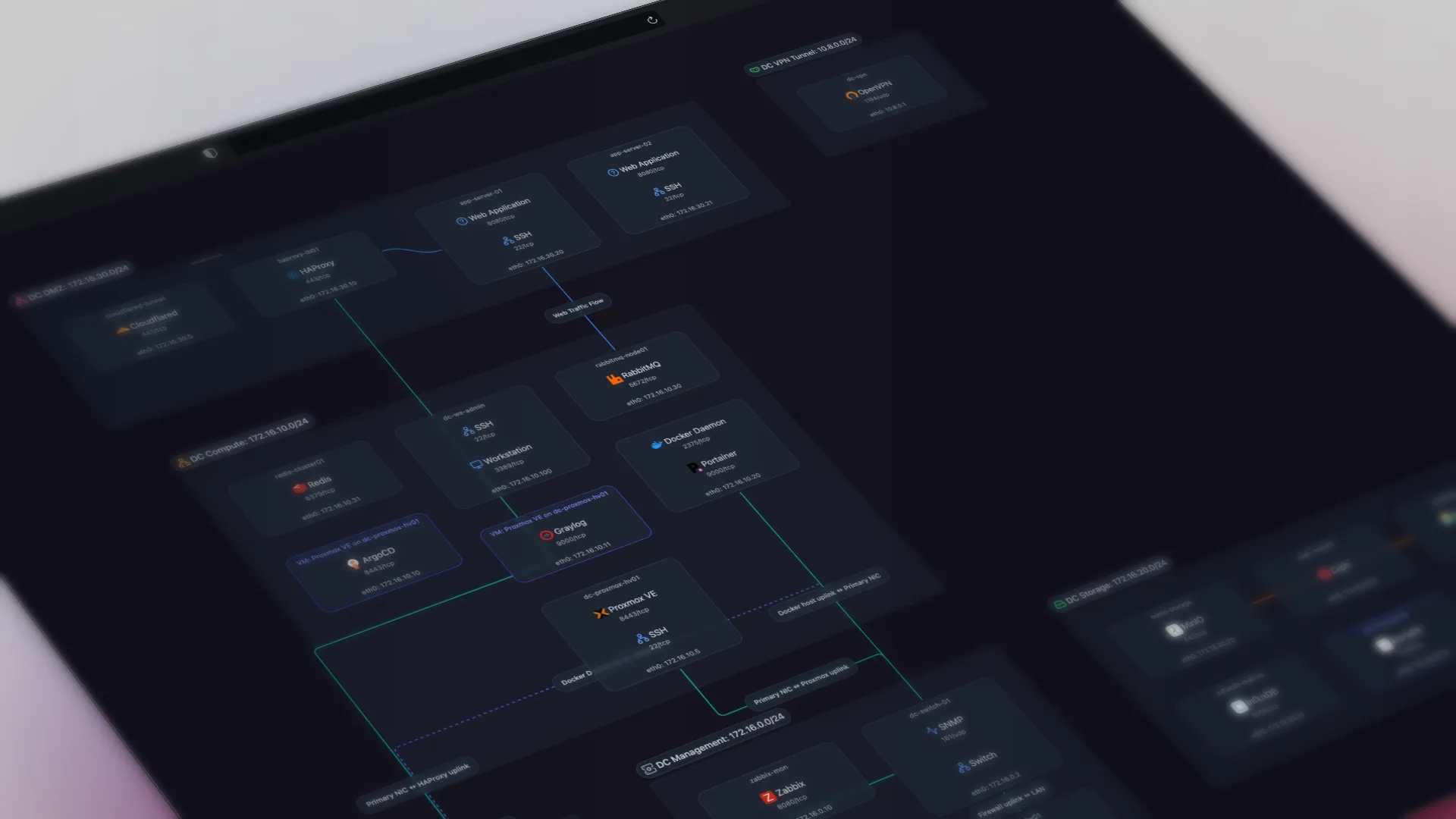
Scanopy is for IT teams and MSPs who want a dedicated network diagram automation tool which works alongside their existing monitoring platform. Domotz is for cost-conscious MSPs who need monitoring, remote access, and basic network maps at a transparent price. The table below puts the two side by side on discovery, the four topology views, pricing, and licensing, including Domotz's trade-offs.
Scanopy vs Domotz: head to head
| Scanopy | Domotz | |
|---|---|---|
| DiscoveryProtocols used to find devices and map connections | SNMP LLDP CDP ARP TCP/UDP | SNMP ARP ICMP CDP LLDP mDNS NetBIOS [5] |
| ServicesNo No service awareness Basic Common port detection Yes Application-level fingerprinting | Yes240+ types | Basic [6] |
| Network ViewsWhich topology views the tool produces from discovery. L2 Physical switch ports and links L3 Subnets, VLANs, routing Workload VM/container host nesting Application Service-dependency / app grouping Yes supported Tag ? unverified Greyed not supported | L2 map confirmed; L3/VLAN mapping is not documented in Domotz help docs. [29] | |
| Live UpdatesWhether diagrams update automatically after the initial scan | Yes | Yes |
| Open SourceOSI OSI-approved open source license Source available Source code available, restricted license No Proprietary | OSI AGPL-3.0 | No |
| PricingStarting price or pricing model | Starts at $11.99 monthly, unlimited hosts | $1.50/device/mo [7] |
| Also IncludesCapabilities beyond network diagramming | Docker Visualization | Monitoring RMM |
How they compare
Domotz and Scanopy both run a single on-site collector and build a Layer 2 topology map with no endpoint agents, so for basic "what's on this network" mapping they overlap. They're built around different priorities, though. Domotz is a monitoring and remote-access platform — its headline value is monitoring, alerting, and secure remote connections into client devices, with network topology as a supporting feature. Scanopy is a dedicated documentation tool: it fingerprints services per host and produces four switchable views (L2, L3, workloads, applications), and it does no monitoring or remote access at all.
The decision usually comes down to scope and price. Domotz is cheap and transparently priced at $1.50/device/month, which is why MSP communities consistently cite it as the most reasonably priced monitoring platform and the go-to lower-cost Auvik alternative. But its pricing is per-device, so a 100-device site is about $150/month, and the mapping sits behind remote access and monitoring. Scanopy is flat monthly with unlimited hosts and has a commercial self-hosted edition or a free, self-hostable AGPL-3.0 Community edition. If you want monitoring, remote access, and a basic map in one affordable platform, Domotz is the stronger pick. If you want deep, exportable, multi-view documentation that sits alongside whatever monitoring you already run, Scanopy is — and the two coexist cleanly on the same network.
On views, Domotz's Layer 2 map is confirmed in its help docs and does the job; the L3/VLAN mapping shows up in its marketing but isn't documented as an actual view, and there's no documented host-to-VM or application view. Scanopy adds L3, workloads, and applications — but Domotz does the monitoring and remote access that Scanopy doesn't touch.
When to choose which
Choose Scanopy when: You want dedicated maps over monitoring + remote access: automatic L2, L3, workload, and application views, per-host service detection, flat pricing regardless of host count, and a free, self-hostable Community edition. It sits alongside your monitoring stack rather than replacing it.
Choose Domotz when: MSPs who want monitoring, remote access, and basic network mapping at a fair price. Domotz is frequently recommended as a fair-priced option in MSP communities.
This is a focused, two-tool comparison.Weighing other options too? See the best Domotz alternatives. For all 13 tools side by side, see the full comparison of automated network diagram tools.
Sources
Try Scanopy
Scanopy deploys a lightweight daemon that discovers your network and builds a live topology map. No per-device fees, unlimited hosts. It pairs with whatever monitoring tool you already use.
Started as a homelabber, now deep in SNMP MIBs, Layer 3 topology, and service fingerprinting - building the network documentation tool I wished existed.