Never maintain another network diagram.
Living network documentation that builds itself — and doesn't stop at the network. Built for modern teams and agents.
52,493
hosts discovered
931
networks mapped
Trusted by teams that manage real infrastructure

Your network isn't documented. It's inferred.
Declared documentation that holds up until drift, manual changes, or anything provisioned outside the pipeline.
Snapshots accurate when someone last updated them. Fiction by month two.
Implicit documentation that walks out the door when people leave.
Observed network documentation that reflects what's actually running. Every host, every dependency, 240+ services.
Visualize your whole network — and everything running on it
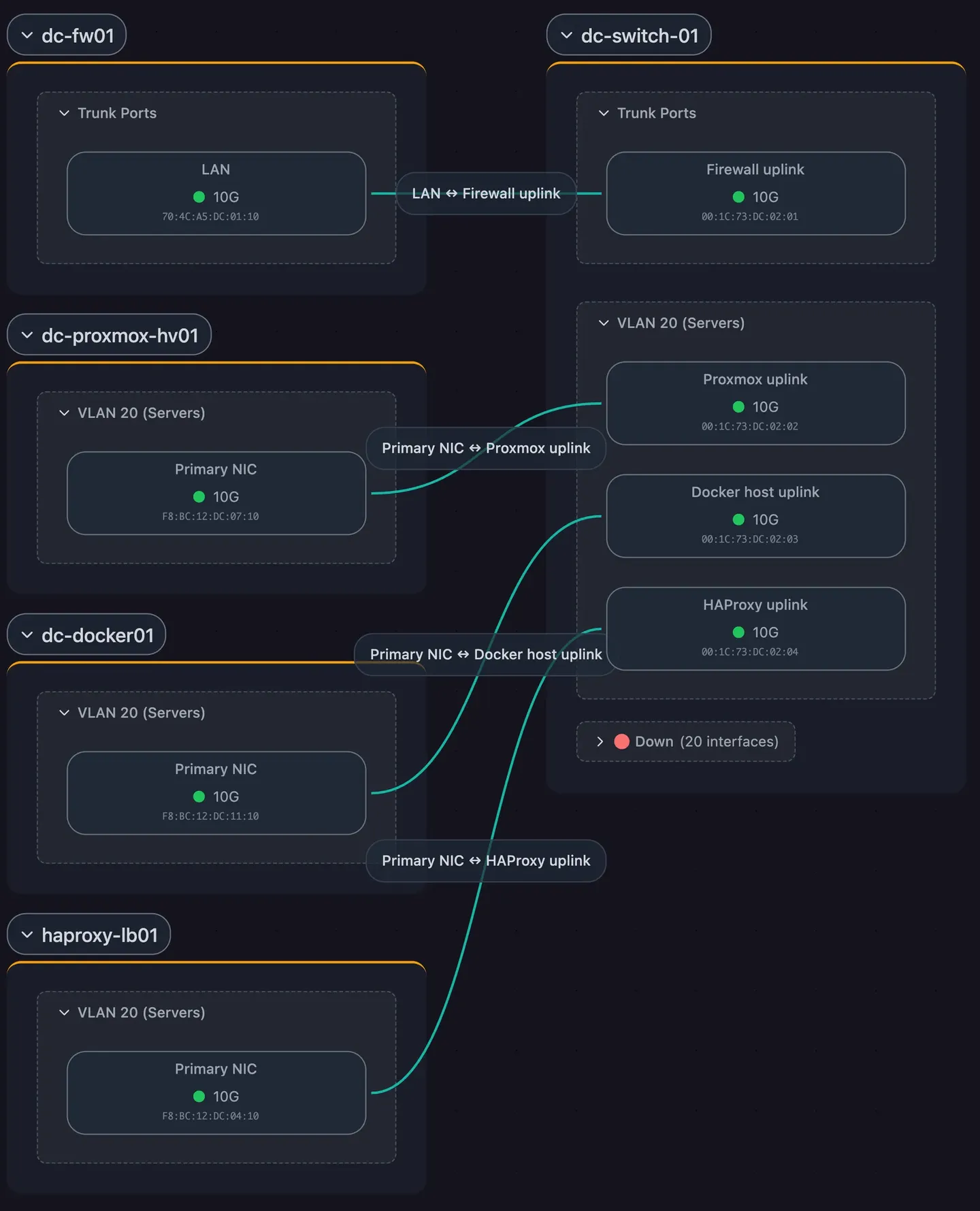
How are our switches wired?
Every switch, every port, every link, with VLANs and port status.
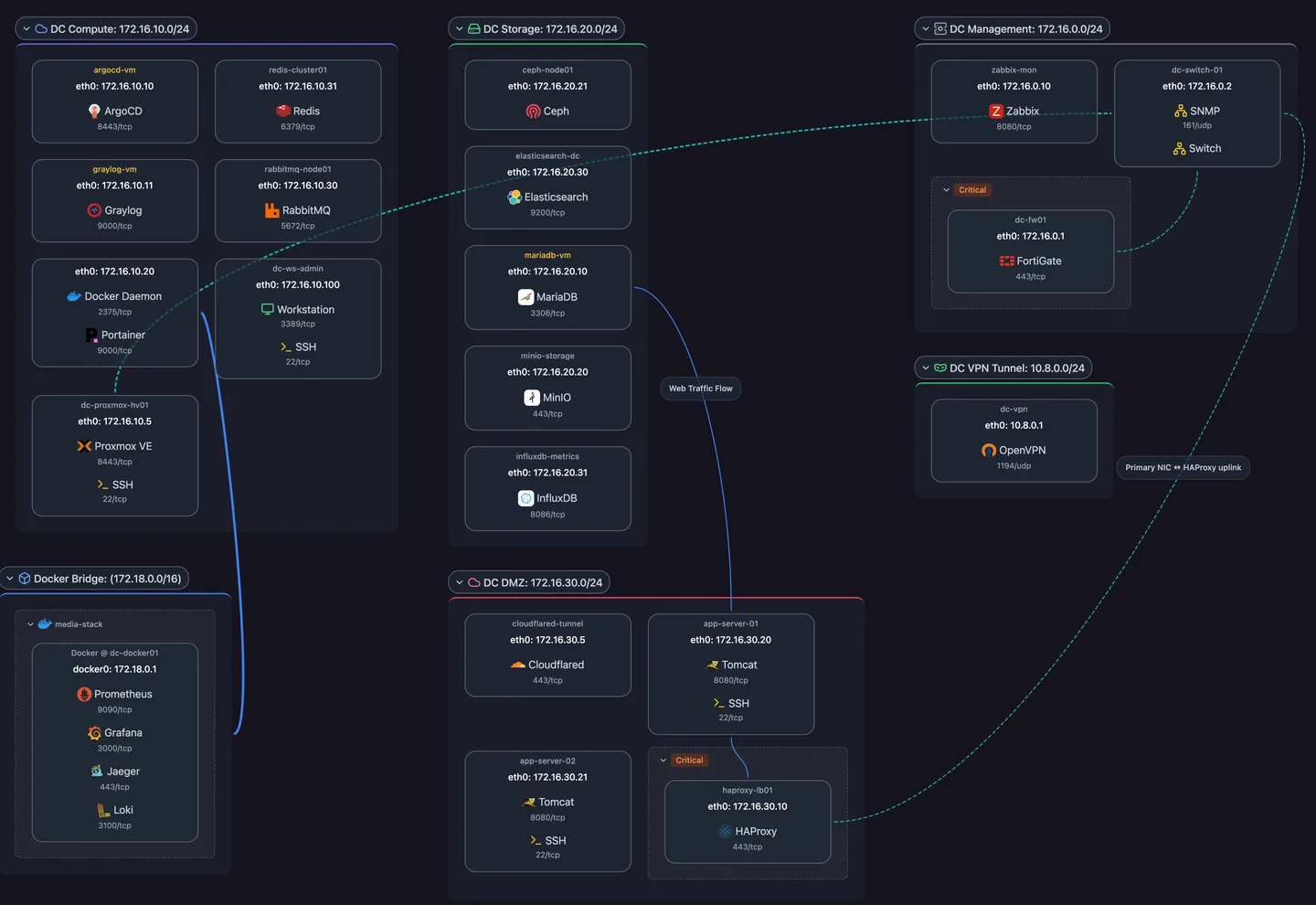
How is our network segmented?
Subnets and how hosts connect across them.
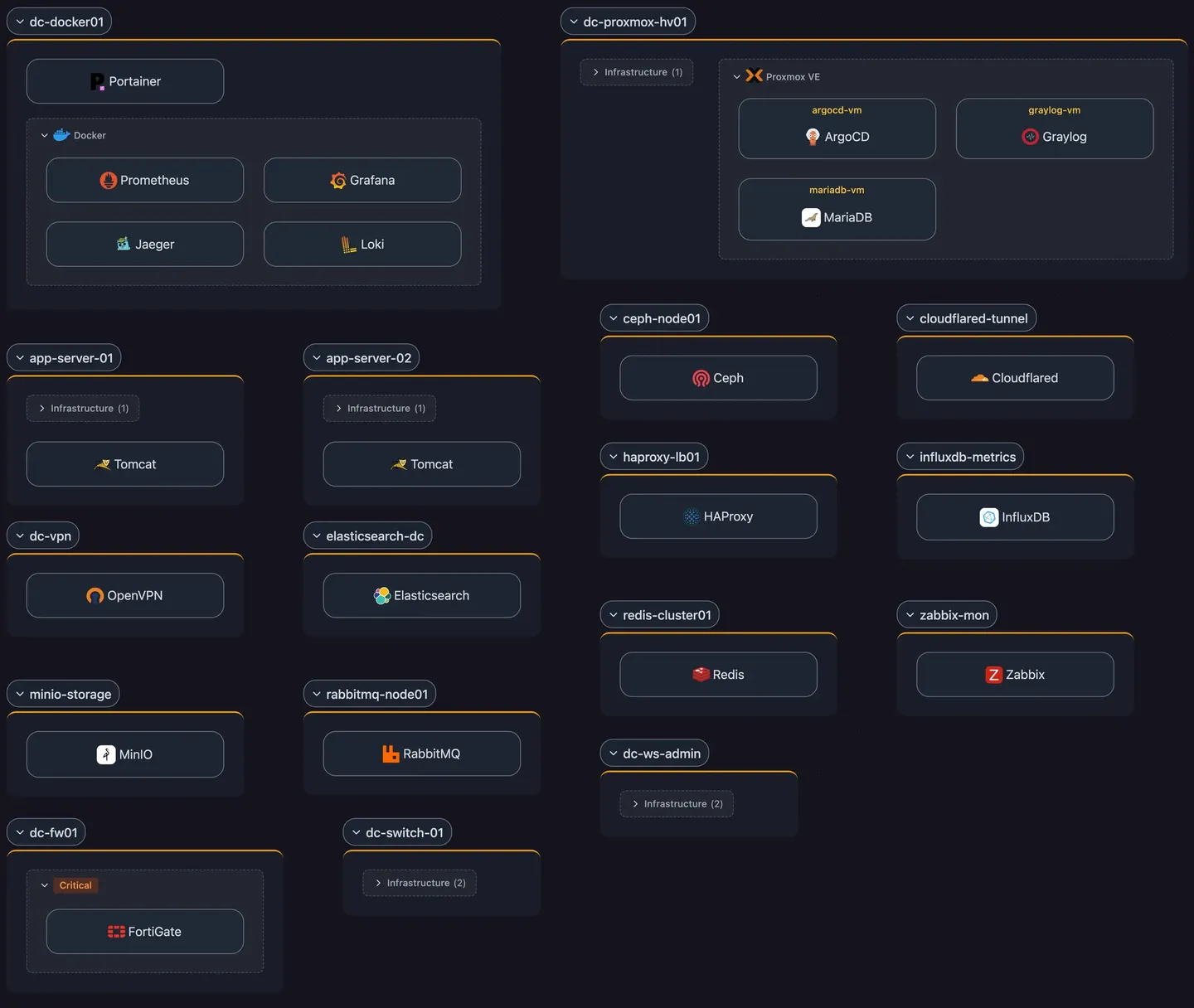
What runs where?
Bare metal to hypervisors to containers. The full nesting chain in one model.
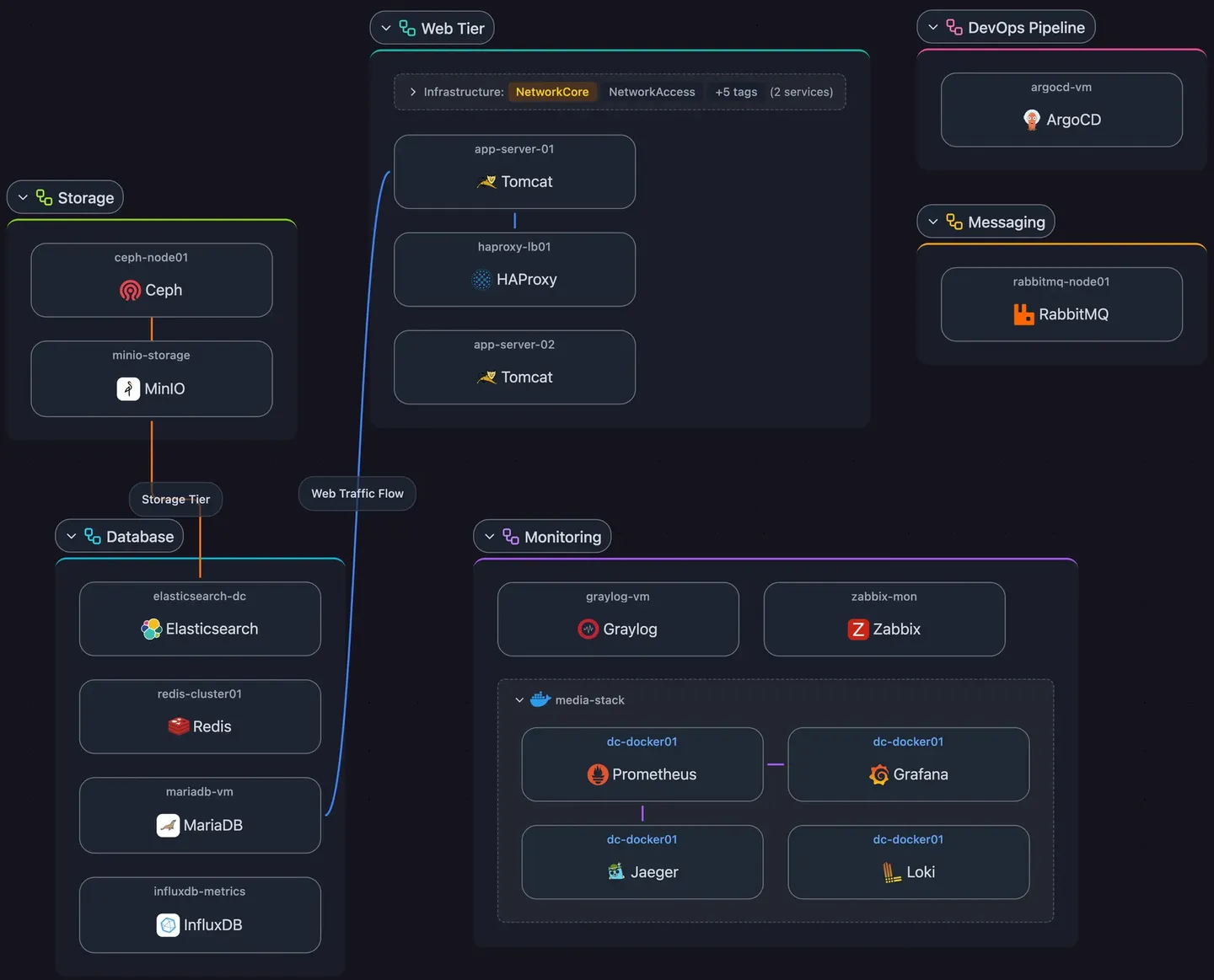
How are our applications structured?
Services and their dependencies, grouped by application.
Fewer fires. Safer changes. Smoother handoffs. Faster onboarding.
Reduce incident response time
See a broken service's dependency chain. Troubleshoot from understanding, not memory.
De-risk changes
Before migrating, resubnetting, or decommissioning a host, see what depends on it.
Simplify post-mortems
Versionable network state shows what changed before something broke.
Eliminate audit scrambles
Export current topology as SVG, PNG, Mermaid, or Confluence markup. One audit-ready artifact per cycle.
Give clients live maps
Shareable live links and embeddable maps, per client. No logins, no stale screenshots.
Onboard engineers faster
New engineers get the infrastructure picture on day one. Four current views, not a stale wiki.
Built for everyone responsible for network infrastructure
IT Operations
Network architecture and physical topology, always current.
MSPs
Per-client documentation with live portals. No logins required.
Security & Compliance
Network segmentation validation and audit-ready documentation.
Platform & DevOps
Service dependencies and workload placement without APM instrumentation.
Featured In

"These don't look like just rough diagrams or Mermaid sketches. The visuals are clean and modern."
- VirtualizationHowto

"A tool that creates a network diagram on its own and keeps it up to date - I think we've all dreamed of that. [Translated]"
- IT-Connect

"It's the network scan + Docker detection combo that makes it useful, because most tools do one or the other but never both. [Translated]"
- Korben

"Built with Rust, Svelte, and TypeScript, it offers a modern alternative to stale manual diagrams like Visio files."
- Marius Hosting

"A very useful tool for corporate network administrators. The larger the network, the less effort it takes to create a diagram and the more ports can be found that are unintentionally open. [Translated]"
- Gigazine
Flat-rate pricing. No per-device fees. Scale without surprises.
Deploy in three steps.
Deploy a scanner
Install a lightweight daemon on any network segment. It discovers hosts, services, subnets, switches, and workloads.
Four views generate automatically
Physical (L2), Logical (L3), Workloads, and Applications. All from one scan.
Stays accurate on a schedule
Rescans on your cadence, so the model never goes stale.
Your living network documentation is minutes away.
What users are saying
"It really helped me catch a couple things that were suboptimal, and be like 'why is that there', and tidy a couple things up."
reinhart_menken"This is sick. I just tried it out on my network and discovery's doing its thing."
discoshanktank"You're literally doing the thing I've dreamed of for ages."
blitz9826"So many features, wasn't expecting a lot more than a simple scanner and a UI."
Medium_Chemist_4032Scanopy is a network documentation platform. A single scanner discovers hosts, maps Layer 2 and Layer 3 topology, and fingerprints 240+ services per host — documenting not just the network but the services, dependencies, and workloads running on it, in four views from one scan and keeping them current on a schedule. The Community Edition is free and open-source (AGPL-3.0); a commercial license lifts the self-host caps, and cloud plans start at $11.99/month. Read how automated network documentation works, compare the best automated network diagram software, or review our security practices.